
Dashcam AD Plus 2.0
AD Plus 2.0 carries two ultra-wide lenses and two separate sets of assists. The front one watches the road and warns about forward collisions, insufficient headway and lane departure. The cabin one watches the driver and reacts to yawning, distraction, phone use, smoking, an unfastened seat belt, no driver and a covered lens. Processing runs inside the device, so the warning arrives while there is still time to react; footage stays on two cards in the vehicle, while the event and its video go to the platform over 4G.
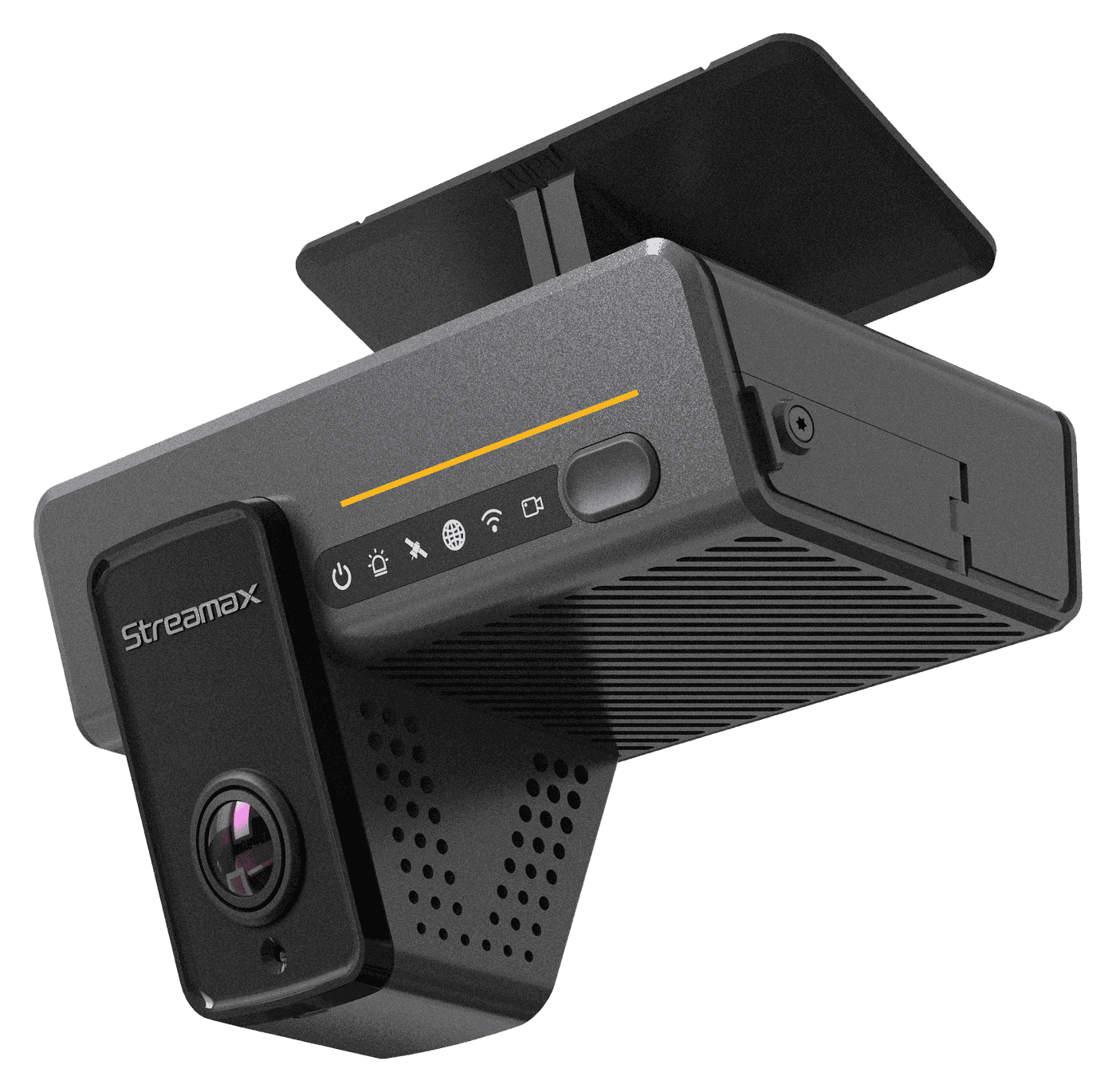
Two lenses, two sets of warnings
The front lens watches the road and speaks up in three situations. FCW warns when the gap to the vehicle ahead is closing faster than braking could undo — a forward collision warning. HMW measures headway in seconds rather than metres and sounds when it drops below a safe value; the same gap that is perfectly fine in city traffic at 50 km/h is too short at 90. LDW flags crossing a line without indicating, which is what happens when attention drifts for a moment.
The cabin lens watches the driver. It reacts to yawning, to distraction when the gaze stays off the road too long, to a phone in the hand, to smoking, to an unfastened seat belt and to the driver's seat being empty. It also detects when the lens itself is covered — because a system that is easily blocked is not a system.
One thing is worth stating precisely: fatigue detection is not the same as yawning. A yawn is a single event visible on the face, while fatigue is assessed over time — how long the eyes stay closed and how the head drops. The manufacturer states that reliable fatigue assessment needs an additional DMS camera, as the built-in algorithm is less accurate for it. Anyone targeting fatigue on long hauls specifically should budget for that addition.
All of the above runs inside the device, with no round trip to a server. That is not a technical footnote but the condition for the warning to mean anything: at 90 km/h a vehicle covers 25 metres per second, so a warning two seconds late arrives fifty metres too late.
Alongside the in-cab warning, the device records the event itself. Footage stays on the cards in the vehicle, while the event and its video clip go to the platform over 4G — with no trip to fetch the card. The same recording then serves twice: as evidence when fault is disputed, and as the basis for a conversation with the driver about what keeps recurring.
road-facing assists — FCW, HMW and LDW
official AD Plus 2.0 product specification
in-cab detections, with fatigue via an additional DMS camera
official AD Plus 2.0 product specification
channels maximum, with additional cameras
official AD Plus 2.0 product specification
Source: official Streamax AD Plus 2.0 product specification.
Key functions
- Road: forward collision warning (FCW), headway monitoring (HMW) and lane departure warning (LDW)
- Cabin: yawning, distraction, phone use, smoking, unfastened seat belt, no driver and a covered lens
- Fatigue detection with an additional DMS camera — the built-in algorithm is less accurate for fatigue
- The warning sounds in the cab immediately, because processing runs inside the device
- Two ultra-wide lenses, recording up to 1080P, expandable to 4 channels
- Two microSD cards up to 1 TB, with simultaneous main and sub-stream recording
- Wi-Fi, Bluetooth, 4G and inertial navigation
- Encrypted data transmission (AES-256, TLS 1.3)
Detailed technical specifications are available on request, based on the manufacturer's official documentation.
Related solutions
Ready to modernise your fleet?
Book a demo or request a quote — our team will propose a solution tailored to your routes, vehicles and goals.